
A pitch deck and a data room do different jobs. The deck is a short narrative that earns you the meeting. The data room is the organized set of documents an investor uses to verify that narrative once they are interested. You need both, in that order, and every number in the first has to survive contact with the second.
This guide explains the difference, what belongs in each, when to share them, and how to keep them consistent so diligence does not turn into an interrogation.
TL;DR
- The deck sells the vision in roughly 10 to 15 slides. The room verifies it with documents an investor reads slowly and often without you present.
- Send the deck first and alone. Open a data room only when an investor asks to move forward, and tier access as interest grows.
- Build the room before you start raising. Every headline metric in the deck must be reproducible from the books.
- Define metrics like ARR once, document the definition, and reconcile the deck to it before you send anything.
- Stress-test the deck against hard investor questions first, because those questions are what the data room will be used to answer.
Table of Contents
- The core difference: persuasion versus verification
- What goes in a pitch deck
- What goes in a data room, by stage
- When to share each one
- How to control access as diligence progresses
- Make the room back up the deck
- Perspective: the room only helps if the deck survives the questions
- Stress-test the deck before anyone opens the room
- A simple raise workflow
- FAQ
- Sources
The core difference: persuasion versus verification
A pitch deck is a sales tool. CRV describes it as the thing that sells the vision and secures meetings, typically in 10 to 15 slides, while the data room is the verification system investors review asynchronously during due diligence. Every claim in the deck gets checked against the room.
Visible.vc frames it the same way: the deck is a narrative covering problem, solution, market, traction, team and ask, and the room is a repository that supports diligence once interest exists. The deck lives inside the room as one document among many. The deck opens the door, and the room handles what comes after.
A useful way to feel the difference is to ask what question each answers. A pre-seed guide from Startup Data Rooms puts it as: the deck answers why an investor should care, and the room answers whether they can trust what you just told them. The deck is skimmed in minutes. The room is read slowly, sometimes by someone you never pitched.
| Pitch deck | Data room | |
|---|---|---|
| Purpose | Generate interest, win meetings | Verify claims, support diligence |
| Format | 10 to 15 slides, narrative | Folders of documents, contracts, financials |
| Reader | Partner skimming for a decision | Associates, counsel, analysts reading closely |
| You present it | Yes | No, it must be self-explanatory |
| Shared | Cold outreach and first meetings | After real interest is shown |
| Failure mode | Vague or unconvincing story | Numbers that do not match the story |
What goes in a pitch deck
The deck is deliberately short. It covers the problem, the solution, market, traction, team and the ask. Andreessen Horowitz’s data room guide describes the deck as including your thesis, product vision, competitive landscape, traction, team and a rough roadmap.
What the deck should not contain is raw legal files or long tables of backup. Its job is to make an investor want to see more. Anything that needs proof gets a pointer to the room, not a pasted contract.
The deck is also where your weakest assumptions live in plain sight. A market size built on a top-down guess, a growth rate extrapolated from two months, a retention number with no cohort behind it: these are the lines a partner will pull on first. The data room will later be asked to back them up, so it pays to find them yourself before anyone else does.
What goes in a data room, by stage
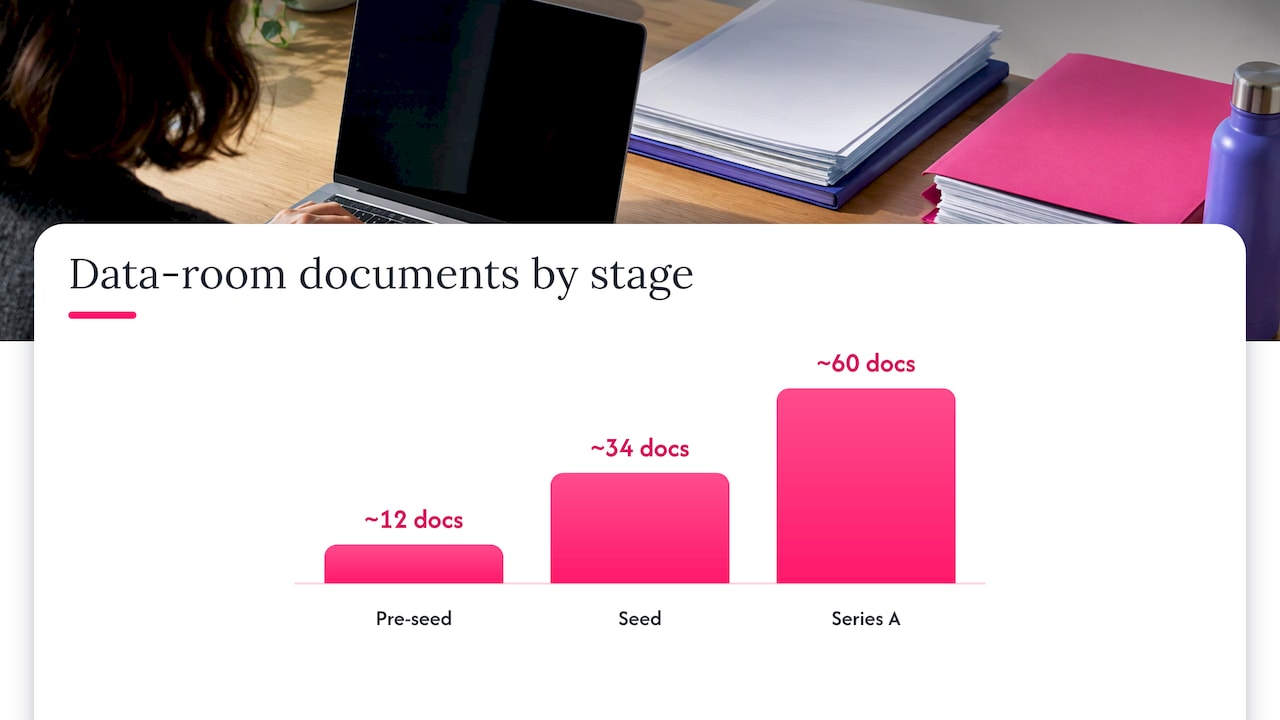
The room scales with the round. Founders often overbuild early, so it helps to know what is typically expected.
Pre-seed
At this stage the room is small. BVJ Consulting’s checklist says that on a pre-seed round of roughly $500K to $2M, a formal data room is generally not expected, and investors mostly ask to verify incorporation and the cap table. Peony’s checklist lists about 12 documents at this stage: the deck, a one-pager, cap table, SAFEs, incorporation documents, IP assignments and founder bios.
HummingDeck’s stage table adds a current financial snapshot to that short list, with the deck leading.
Seed
Seed rounds on SAFEs are often informal. BVJ notes a shared drive can be enough, while a priced seed calls for a formal room and several weeks of diligence. Peony counts about 34 documents by seed, adding items such as a monthly P&L, financial model, KPI dashboard, customer contracts, a 409A valuation and tax returns.
CRV’s guidance for seed-stage founders includes historical P&L statements since inception, a year-to-date P&L, the latest balance sheet and multi-year projections covering revenue by segment, cost of sales, operating expenses and EBITDA.
Series A
Series A is where the room gets heavy. Peony’s checklist grows to about 60 documents, including revenue by customer, unit economics, all material contracts, board minutes and an open-source audit. HummingDeck describes a deeper, request-led process covering longer financial history, ownership and financing records, customer concentration, governance, IP ownership, employment records and security or privacy material.
What the experts say to leave out
More is not better. Andreessen Horowitz recommends five core items: the deck, a cap table, historical P&L and burn, usage data, and LTV/CAC with payback period. It also lists items often seen but not recommended unless an investor asks, such as detailed 3 to 5 year projections, tax returns and legal documents, redacted board minutes, and market sizing, since investors do their own market work.
A sensible default: start from the core items, then add what a specific investor requests. Documents you upload are documents you must defend.
When to share each one
The sequence matters more than the contents. A simple rule from the research: the deck opens conversations and the room closes them. One stage-by-stage breakdown describes cold outreach and first meetings running on the deck alone, a second meeting or metrics question earning a light room (deck, cap table, metrics, summary financials), and a term sheet opening full diligence.
Founder’s Dataroom describes the same tiering: after a strong first or second meeting share the basics, once an investor signals real intent open the financial model and customer references, and after a term sheet make everything available, including legal documents and operational data.
Visible.vc offers a rule of thumb worth remembering: if an investor has not asked for more information, they are not ready for your data room.
Why not open everything on day one
ReportRoom summarizes a view from VC Mark Suster that opening a full room too early gives lukewarm investors an easy way to stall with endless document requests instead of making a decision. A data-room request with no follow-up meeting booked is weak intent.
Why you still build it early
The same source relays a16z’s advice to prepare the room before the process starts, because scrambling mid-raise slows rounds down. It cites 2024 data showing pre-seed rounds taking about 12 weeks to close, so the room should be ready in week one, not assembled in week six. Preparing early and sharing late are not in conflict.
How to control access as diligence progresses
Treat access as a signal of seriousness and a security matter. Glencoyne’s security guide recommends role-based groups from the start rather than file-by-file permissions. A typical setup has three to four tiers:
- Initial look: non-confidential deck and a one-page summary, with downloads and printing disabled.
- Engaged review: an anonymized customer case study, high-level projections and team bios, mostly view-only.
- Active diligence: detailed monthly financials, the full cap table and key customer contracts, for investors with serious intent or a signed NDA.
- Specialist diligence: narrow access, such as patents or corporate legal, for an investor’s counsel or technical team.
Gruv’s access-control guide adds least-privilege defaults, watermarking, timed access expiry and a downloadable audit trail, with external users starting view-only and downloads granted only to named users and specific folders.
An organized room also communicates something. CRV says a meticulous room signals the operational discipline investors look for, which suggests the business will be run well after they invest.
Make the room back up the deck
The most common way founders lose momentum is not a missing document. It is a number in the deck that the room cannot reproduce.
StartupCFO gives a concrete example: if the deck says $1.4M ARR and monthly revenue times 12 in the room suggests $1.1M, the investor will ask, and your explanation becomes the problem. The advice is to pick one ARR definition, document it on a one-page methodology note in the room, and reconcile every deck figure to it before sending.
CRV makes the same point: ARR in the deck should match the accounting file exactly, and conflicting numbers kill momentum and erode trust. CFOmatrix puts it bluntly: once a diligence team cannot rebuild your ARR from the ledger and bank statements, they stop trusting your other numbers. Define each metric, apply it consistently, and keep the bridge from every headline number to recognized revenue.
A practical reconciliation pass before you send the deck:
- List every number on every slide: revenue, growth, retention, CAC, LTV, burn, runway, round size.
- Next to each, write the document in the room that supports it and the exact definition used.
- Recompute each figure from the underlying file. Fix the deck or the file, never leave a gap.
- Reconcile the cap table to your equity records, with every issuance tied to a board consent.
- Re-run the pass whenever a new month closes, so the room stays current.
For teams that want to see how cited, document-backed answers work in practice, a data room Q&A with cited answers shows how each claim can point back to the evidence behind it.
Perspective: the room only helps if the deck survives the questions
We see founders spend weeks on folder structure and almost no time on the questions the folders will be used to answer. A tidy room does not rescue a deck with a fragile assumption in it. It just gives an investor a faster route to the weak spot.
That is why we built Dialectic around adversarial, partner-style scrutiny rather than supportive feedback. Polite comments tell you the deck reads well. Hard questions tell you where a market size, a margin or a growth claim will crack, so you can fix it before the data room is ever opened.
Our approach is to treat the deck and the room as one chain. Find the claims a skeptical partner would attack, decide what evidence answers each one, and rehearse the defense out loud. Founders who walk into a meeting having already faced the lethal questions answer them with documents and calm, not improvisation.
D
Stress-test the deck before anyone opens the room
The data room verifies what the deck claims, so the deck is where to look for trouble first. If you can predict the hardest questions a partner will ask about your unit economics, defensibility or market, you know which documents the room must contain and which numbers need a bridge.
Dialectic is built for exactly that step. You upload a deck or memo, and the platform scrutinizes it the way a seasoned VC partner would, flagging fragile assumptions and blind spots, scoring fragility and risk, and giving structured feedback on what to fix. You can then rehearse in a real-time boardroom session with a graded defense against tough, realistic questions.
The published options are a Tactical Audit at $25 per audit, Founder Pro at $49 per month, and Venture & Studio 5 Seats at $149 per month. You can see all three on the Dialectic site, or look at a worked example in the Nexus take-rate teardown, where a board memo gets red-teamed.

If you are about to send a deck to investors, run it through an adversarial pitch deck review first, then build the room around the weak spots it surfaces.
A simple raise workflow
- Before you raise: reconcile deck numbers to the books, define ARR and other metrics, and assemble the core room documents for your stage.
- Before first outreach: stress-test the deck against hard investor questions and fix the assumptions that do not hold.
- First meetings: send the deck alone. Offer more only when the investor asks.
- Second meeting or metrics request: open the light room, with deck, cap table, headline metrics and summary financials, under view-only access.
- Serious intent or term sheet: move the investor to deeper tiers, with an NDA where appropriate, and add specialist access for counsel.
- Throughout: keep the room current. A room that reads as maintained signals a well-run company, as CFOmatrix’s finance lead puts it.
FAQ
Do I need a data room at pre-seed?
Usually only a small one. BVJ Consulting notes that investors at this stage mostly want to verify incorporation and the cap table. Have your deck, cap table, SAFEs, formation records and IP assignments organized, and expand only when an investor asks for more.
Should the pitch deck go inside the data room?
Yes. The deck is typically one document in the room, usually the first, since it frames everything else. The difference is timing: the deck goes out alone at the start, while the room opens later to investors who signal real interest.
When should I send the data room link?
After an investor shows genuine intent, such as a strong second meeting, a detailed metrics question or a term sheet. Tier access as interest grows rather than opening everything at once, so lukewarm investors cannot stall you with endless document requests.
What is the most common mismatch between a deck and a data room?
Headline metrics that the books cannot reproduce, with ARR as the classic case. Choose one definition, document it, and reconcile every deck figure to the ledger and bank statements before you send anything.
Sources
- CRV: Data Room Setup
- Visible.vc: Startup Data Room
- Startup Data Rooms: Pitch deck vs data room for pre-seed
- Andreessen Horowitz: The Insider’s Guide to Data Rooms
- BVJ Consulting: Data Room Checklist
- Peony: Data Room for Investors Checklist
- HummingDeck: Data room for investors checklist
- Free Data Rooms: Pitch Deck vs. Data Room
- Founder’s Dataroom: When to share your data room
- ReportRoom: Data rooms for startups
- Glencoyne: Virtual Data Room Security
- Gruv: Data room access controls
- StartupCFO: Data room red flags
- CFOmatrix: SaaS Data Room checklist
- Revoxy: Data room Q&A with cited answers
Leave a Reply